TLDR: The Jensen v. ATF ruling (August 5, 2026) is real and significant—but it does not wipe out suppressor regulations nationwide. Where you live, whether you belong to a plaintiff organization, and what your state law says all determine what, if anything, has actually changed for you. This article breaks it down for every state and Washington, D.C.
If you’ve seen headlines declaring suppressors are now “legal everywhere” or “unregulated in 42 states,” slow down. Those headlines are doing way more work than the actual ruling supports. The truth is layered, state-specific, and still evolving which is exactly why we wanted to put together a clear, honest breakdown for our customers here at Capitol Range and gun owners across the country.
One thing upfront: this is general educational content, not legal advice. NFA law is moving fast right now, and the Fifth Circuit appeal is still active. If you have a specific situation—pending Form 4, NFA trust, membership in a plaintiff organization—talk to a qualified firearms attorney before you act on anything you read here.
Why Suppressors Were Regulated in the First Place
Before we get into the ruling, a little context helps.

The National Firearms Act of 1934 (NFA) placed suppressors, short-barreled rifles, short-barreled shotguns, machine guns, and a few other items under a federal registration and approval system. To buy or make one, you had to submit an ATF form, pass a background check, wait for approval, and pay a $200 tax. That $200 hasn’t changed since 1934—but $200 in 1934 was roughly $4,500 in today’s money. The tax was a price barrier, plain and simple.
Here’s the legal detail that makes the 2026 ruling possible: the NFA was written as a tax law, not a straightforward regulatory statute. Congress used its taxing power in 1934 because it didn’t have a clean path to outright ban these items. The Supreme Court upheld the NFA in 1937 specifically on those grounds—it was a revenue measure, and the registration system existed to support tax collection.
That matters a lot for what happened next.
In 2025, Congress passed the One Big Beautiful Bill Act, which zeroed out the $200 NFA tax on suppressors, short-barreled rifles, short-barreled shotguns, and “any other weapons,” effective January 1, 2026. The Form 4 process stayed. The background check stayed. But the tax—the constitutional load-bearing wall of the whole NFA framework for those items—went to zero.
That set up an obvious question: if the registration scheme was built on Congress’s power to collect a tax, what happens to the scheme when the tax disappears?
The Ruling: Jensen v. ATF
On August 5, 2026, U.S. District Judge James Wesley Hendrix of the Northern District of Texas answered that question. In Jensen v. ATF (consolidated with Silencer Shop Foundation v. ATF), the court ruled that once Congress zeroed out the tax, it also removed the constitutional foundation for the NFA’s registration and approval requirements—for suppressors, SBRs, SBSs, and AOWs.
A few key things to understand about this ruling before we get to the state breakdown:
It’s a tax-law case, not a Second Amendment case. The plaintiffs dropped their Second Amendment arguments and won entirely on the question of congressional taxing authority. The court never ruled that suppressors are constitutionally protected arms—it ruled that the method Congress used to regulate them no longer has a valid foundation.
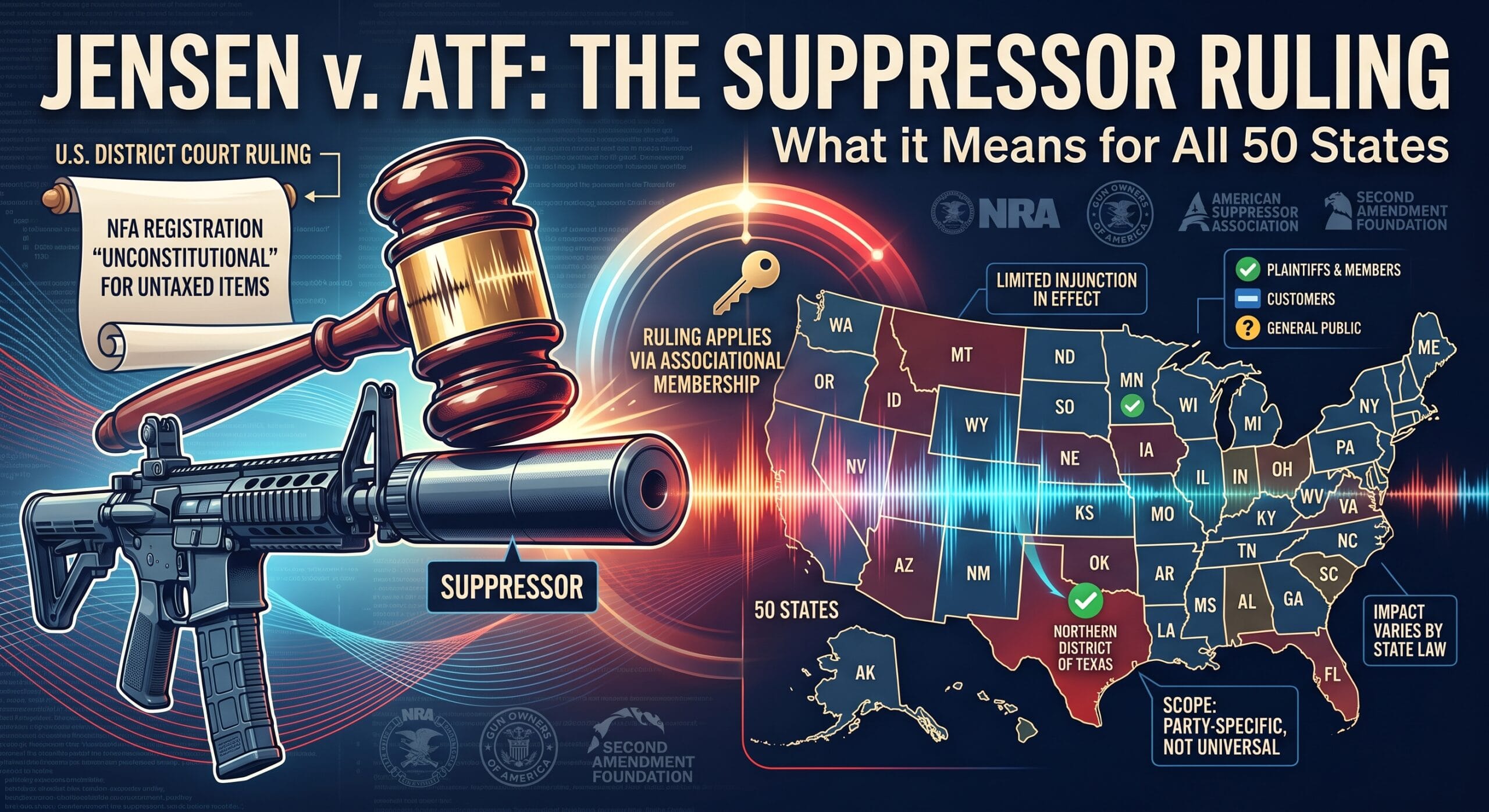
It is not a nationwide injunction. The court expressly declined to issue a universal order protecting every American. Relief runs to the named plaintiffs, members of the plaintiff organizations, and customers of the specific commercial businesses involved in the case.
The stay lapsed, but the appeal is coming. The court paused its order for seven days to let the DOJ seek appellate relief. That window closed August 12 without a stay from the Fifth Circuit—so the injunction is technically in force for those it covers. But the government’s appeal window hasn’t closed, and this case is widely expected to head to the Fifth Circuit and possibly the Supreme Court.
State law is unaffected. A federal court ruling cannot override a state ban. If your state prohibits civilian suppressor ownership, that remains true regardless of what any federal court says.
The Three Groups: Where Every State Fall
There is no single answer to “what does this mean for my state?” Every state falls into one of three categories—and even within those categories, individual circumstances vary.
🟡 Group 1 — The 15 Plaintiff States (Limited Protection for Qualifying Individuals)
These states joined the lawsuit directly. The injunction protects the state governments, their agencies, and their political subdivisions—but not every resident automatically. Protection runs to named parties, qualifying organization members, and customers of the specific businesses in the case. Simply living in one of these states does not put you under the ruling’s umbrella.
| State | Plaintiff State? | State Suppressor Ban? | What Changes for Most Residents? |
|---|---|---|---|
| Texas | ✅ Yes | ❌ No ban | Limited—must qualify via plaintiff membership or covered transaction |
| Alaska | ✅ Yes | ❌ No ban | Limited—must qualify via plaintiff membership or covered transaction |
| Georgia | ✅ Yes | ❌ No ban | Limited—must qualify via plaintiff membership or covered transaction |
| Idaho | ✅ Yes | ❌ No ban | Limited—must qualify via plaintiff membership or covered transaction |
| Indiana | ✅ Yes | ❌ No ban | Limited—must qualify via plaintiff membership or covered transaction |
| Kansas | ✅ Yes | ❌ No ban | Limited—must qualify via plaintiff membership or covered transaction |
| Louisiana | ✅ Yes | ❌ No ban | Limited—must qualify via plaintiff membership or covered transaction |
| Montana | ✅ Yes | ❌ No ban | Limited—must qualify via plaintiff membership or covered transaction |
| North Dakota | ✅ Yes | ❌ No ban | Limited—must qualify via plaintiff membership or covered transaction |
| Oklahoma | ✅ Yes | ❌ No ban | Limited—must qualify via plaintiff membership or covered transaction |
| South Carolina | ✅ Yes | ❌ No ban | Limited—must qualify via plaintiff membership or covered transaction |
| South Dakota | ✅ Yes | ❌ No ban | Limited—must qualify via plaintiff membership or covered transaction |
| Utah | ✅ Yes | ❌ No ban | Limited—must qualify via plaintiff membership or covered transaction |
| West Virginia | ✅ Yes | ❌ No ban | Limited—must qualify via plaintiff membership or covered transaction |
| Wyoming | ✅ Yes | ❌ No ban | Limited—must qualify via plaintiff membership or covered transaction |
⚠️ Important: Even in plaintiff states, you are not automatically protected. Consult a firearms attorney to confirm whether your specific status—individual, trust, LLC—qualifies for coverage under the injunction.
🟢 Group 2 — Suppressor-Legal Non-Plaintiff States (Standard Form 4 Process Continues for Most)
These states allow suppressor ownership under state law, but they were not party to the Jensen litigation. For the vast majority of residents, the standard ATF Form 4 process still applies—with one meaningful improvement: the $200 tax stamp fee is gone thanks to the One Big Beautiful Bill Act. The paperwork, background check, and ATF approval? Still required.
If you’re a member of one of the plaintiff organizations (Gun Owners of America, Second Amendment Foundation, FPC Action Foundation, etc.) or purchased through a named commercial plaintiff, you may have additional protections regardless of your state. Talk to an attorney to find out.
| State | Plaintiff State? | State Suppressor Ban? | What Changes for Most Residents? |
|---|---|---|---|
| Alabama | ❌ No | ❌ No ban | $200 tax gone; Form 4 process unchanged |
| Arizona | ❌ No | ❌ No ban | $200 tax gone; Form 4 process unchanged |
| Arkansas | ❌ No | ❌ No ban | $200 tax gone; Form 4 process unchanged |
| Colorado | ❌ No | ❌ No ban | $200 tax gone; Form 4 process unchanged |
| Connecticut | ❌ No | ❌ No ban | $200 tax gone; Form 4 process unchanged |
| Florida | ❌ No | ❌ No ban | $200 tax gone; Form 4 process unchanged |
| Iowa | ❌ No | ❌ No ban | $200 tax gone; Form 4 process unchanged |
| Kentucky | ❌ No | ❌ No ban | $200 tax gone; Form 4 process unchanged |
| Maine | ❌ No | ❌ No ban | $200 tax gone; Form 4 process unchanged |
| Maryland | ❌ No | ❌ No ban | $200 tax gone; Form 4 process unchanged |
| Michigan | ❌ No | ❌ No ban | $200 tax gone; Form 4 process unchanged |
| Minnesota | ❌ No | ❌ No ban | $200 tax gone; Form 4 process unchanged |
| Mississippi | ❌ No | ❌ No ban | $200 tax gone; Form 4 process unchanged |
| Missouri | ❌ No | ❌ No ban | $200 tax gone; Form 4 process unchanged |
| Nebraska | ❌ No | ❌ No ban | $200 tax gone; Form 4 process unchanged |
| Nevada | ❌ No | ❌ No ban | $200 tax gone; Form 4 process unchanged |
| New Hampshire | ❌ No | ❌ No ban | $200 tax gone; Form 4 process unchanged |
| New Mexico | ❌ No | ❌ No ban | $200 tax gone; Form 4 process unchanged |
| North Carolina | ❌ No | ❌ No ban | $200 tax gone; Form 4 process unchanged |
| Ohio | ❌ No | ❌ No ban | $200 tax gone; Form 4 process unchanged |
| Oregon | ❌ No | ❌ No ban | $200 tax gone; Form 4 process unchanged |
| Pennsylvania | ❌ No | ❌ No ban | $200 tax gone; Form 4 process unchanged |
| Tennessee | ❌ No | ❌ No ban | $200 tax gone; Form 4 process unchanged |
| Vermont | ❌ No | ❌ No ban | $200 tax gone; Form 4 process unchanged |
| Virginia | ❌ No | ❌ No ban | $200 tax gone; Form 4 process unchanged |
| Wisconsin | ❌ No | ❌ No ban | $200 tax gone; Form 4 process unchanged |
North Carolina note: We’re a Group 2 state. For Capitol Range customers, the practical takeaway is straightforward—the $200 tax is gone, but the Form 4 process is otherwise unchanged. Come see us and we’ll walk you through it.
🔴 Group 3 — State-Level Suppressor Bans (Federal Ruling Changes Nothing Here)
These nine jurisdictions ban civilian suppressor ownership under their own state laws. A federal court ruling about the NFA’s constitutional basis does not touch state law. Even if the federal registration requirement eventually disappears entirely, residents of these states would still need their state law to change before suppressor ownership becomes legal for them.
| Jurisdiction | State Suppressor Ban? | Impact of Jensen Ruling |
|---|---|---|
| California | ✅ Yes | No change—state ban remains in full effect |
| Delaware | ✅ Yes | No change—state ban remains in full effect |
| Hawaii | ✅ Yes | No change—state ban remains in full effect |
| Illinois | ✅ Yes | No change—state ban remains in full effect |
| Massachusetts | ✅ Yes | No change—state ban remains in full effect |
| New Jersey | ✅ Yes | No change—state ban remains in full effect |
| New York | ✅ Yes | No change—state ban remains in full effect |
| Rhode Island | ✅ Yes | No change—state ban remains in full effect |
| Washington, D.C. | ✅ Yes | No change—state/local ban remains in full effect |
Note: Separate ASA-backed litigation is currently active in Illinois and New Jersey challenging those state bans directly. Those are different cases, different legal theories, and not part of Jensen.
Complete State-by-State Reference
Here’s every state and D.C. in one place. Use this as a quick-reference guide—but remember, your individual circumstances (trust ownership, organization membership, pending transfers) may change the picture. When in doubt, verify with a firearms attorney.
| State / Jurisdiction | Plaintiff State? | State Ban? | $200 Tax Gone? | Form 4 Still Required for Most? |
|---|---|---|---|---|
| Alabama | ❌ | ❌ | ✅ | ✅ |
| Alaska | ✅ | ❌ | ✅ | Varies by plaintiff status |
| Arizona | ❌ | ❌ | ✅ | ✅ |
| Arkansas | ❌ | ❌ | ✅ | ✅ |
| California | ❌ | ✅ | ✅ | State ban applies |
| Colorado | ❌ | ❌ | ✅ | ✅ |
| Connecticut | ❌ | ❌ | ✅ | ✅ |
| Delaware | ❌ | ✅ | ✅ | State ban applies |
| Florida | ❌ | ❌ | ✅ | ✅ |
| Georgia | ✅ | ❌ | ✅ | Varies by plaintiff status |
| Hawaii | ❌ | ✅ | ✅ | State ban applies |
| Idaho | ✅ | ❌ | ✅ | Varies by plaintiff status |
| Illinois | ❌ | ✅ | ✅ | State ban applies |
| Indiana | ✅ | ❌ | ✅ | Varies by plaintiff status |
| Iowa | ❌ | ❌ | ✅ | ✅ |
| Kansas | ✅ | ❌ | ✅ | Varies by plaintiff status |
| Kentucky | ❌ | ❌ | ✅ | ✅ |
| Louisiana | ✅ | ❌ | ✅ | Varies by plaintiff status |
| Maine | ❌ | ❌ | ✅ | ✅ |
| Maryland | ❌ | ❌ | ✅ | ✅ |
| Massachusetts | ❌ | ✅ | ✅ | State ban applies |
| Michigan | ❌ | ❌ | ✅ | ✅ |
| Minnesota | ❌ | ❌ | ✅ | ✅ |
| Mississippi | ❌ | ❌ | ✅ | ✅ |
| Missouri | ❌ | ❌ | ✅ | ✅ |
| Montana | ✅ | ❌ | ✅ | Varies by plaintiff status |
| Nebraska | ❌ | ❌ | ✅ | ✅ |
| Nevada | ❌ | ❌ | ✅ | ✅ |
| New Hampshire | ❌ | ❌ | ✅ | ✅ |
| New Jersey | ❌ | ✅ | ✅ | State ban applies |
| New Mexico | ❌ | ❌ | ✅ | ✅ |
| New York | ❌ | ✅ | ✅ | State ban applies |
| North Carolina | ❌ | ❌ | ✅ | ✅ |
| North Dakota | ✅ | ❌ | ✅ | Varies by plaintiff status |
| Ohio | ❌ | ❌ | ✅ | ✅ |
| Oklahoma | ✅ | ❌ | ✅ | Varies by plaintiff status |
| Oregon | ❌ | ❌ | ✅ | ✅ |
| Pennsylvania | ❌ | ❌ | ✅ | ✅ |
| Rhode Island | ❌ | ✅ | ✅ | State ban applies |
| South Carolina | ✅ | ❌ | ✅ | Varies by plaintiff status |
| South Dakota | ✅ | ❌ | ✅ | Varies by plaintiff status |
| Tennessee | ❌ | ❌ | ✅ | ✅ |
| Texas | ✅ | ❌ | ✅ | Varies by plaintiff status |
| Utah | ✅ | ❌ | ✅ | Varies by plaintiff status |
| Vermont | ❌ | ❌ | ✅ | ✅ |
| Virginia | ❌ | ❌ | ✅ | ✅ |
| Washington | ❌ | ❌ | ✅ | ✅ |
| Washington, D.C. | ❌ | ✅ | ✅ | D.C. ban applies |
| West Virginia | ✅ | ❌ | ✅ | Varies by plaintiff status |
| Wisconsin | ❌ | ❌ | ✅ | ✅ |
| Wyoming | ✅ | ❌ | ✅ | Varies by plaintiff status |
What Should You Do Right Now?
Let’s keep this practical.
You have a pending Form 4. Keep waiting. The ATF approval process has not been suspended for the general public. Don’t pull your application or assume you’re off the hook for approval—that could create serious legal exposure. Sit tight.
You’re a member of a plaintiff organization (Gun Owners of America, Second Amendment Foundation, FPC Action Foundation, Citizens Committee for the Right to Keep and Bear Arms, or Texas State Rifle Association). Your situation may be different. Talk to a firearms attorney to understand whether and how the injunction covers your specific transaction—especially if a trust or LLC is involved.
You’re a typical North Carolina gun owner. The process is essentially unchanged for you. North Carolina is a Group 2 state—suppressor ownership is legal here, but the standard Form 4 process (now minus the $200 tax) is still the path forward. Come by Capitol Range and we’ll walk you through it.
You live in one of the 9 ban states. The Jensen ruling doesn’t help you—not yet. Federal courts can’t override state law. Your path forward depends on your state legislature or separate litigation targeting your state’s specific ban.
No matter where you live: always check your state law first and consult a firearms attorney before making any decisions based on this ruling.
Where Does This Go From Here?
Jensen v. ATF is one of the most significant NFA-adjacent rulings in decades. But it’s a district court decision with an active appeal, not settled law. Here’s what to watch:
- Fifth Circuit appeal — The government is expected to appeal. The Fifth Circuit could affirm, narrow, or reverse the ruling. A stay could also put the injunction on hold while the appeal proceeds.
- Parallel challenges in Missouri and Kentucky — Related NFA cases are pending in those districts. A circuit split could push this to the Supreme Court faster.
- Congressional action — Congress could reinstate a nominal nonzero tax, expressly reenact the regulatory scheme under the Commerce Clause, or pass the Hearing Protection Act, which would remove suppressors from the NFA entirely. Any of those moves would trigger new litigation.
- State-level bans — Separate ASA-backed cases are active in Illinois and New Jersey. Those are fights for another day, but they matter for residents in ban states.
We’ll keep this page updated as the Fifth Circuit appeal develops. Check back, bookmark it, and if you have questions in the meantime, stop by Capitol Range. Our staff can walk you through the current Form 4 process, and we always recommend confirming anything NFA-related with a qualified firearms attorney before you buy, transfer, or build.
Frequently Asked Questions
Does Jensen v. ATF mean suppressors are legal everywhere now?
No. The ruling is party-specific, not nationwide. Nine jurisdictions still ban suppressors under state law. In the remaining states, the standard Form 4 process still applies for most residents.
Do I still need to file a Form 4 in North Carolina?
Yes. North Carolina was not a plaintiff state. The $200 tax is gone, but the Form 4, background check, and ATF approval are still required for most NC residents.
Is the $200 tax stamp gone?
Yes—but only the tax. Congress zeroed it out effective January 1, 2026. The Form 4 registration process itself remains in place for most gun owners.
I have a Form 4 pending. What should I do?
Keep waiting. Don’t withdraw your application. If you have concerns about your specific situation, talk to a firearms attorney.
Does joining a plaintiff organization give me coverage under the ruling?
Potentially, yes—but it’s not automatic, and there are nuances around trusts, LLCs, specific firearm categories, and which organization you belong to. Talk to a qualified attorney before assuming you’re covered.
What about residents of California, Illinois, New Jersey, or other ban states?
The Jensen ruling doesn’t change your state law. Suppressor ownership remains prohibited under your state’s statute regardless of what federal courts do. Separate litigation targeting those state bans is ongoing.
This article is for general educational purposes only and does not constitute legal advice. Firearms laws vary by state and are changing quickly in 2026. Verify current requirements with the ATF and a licensed attorney before taking any action. Capitol Range will update this page as the Fifth Circuit appeal in Jensen v. ATF develops.